
Canvas Weave Mapping
When two paintings share the same bolt of linen, the threads say so.
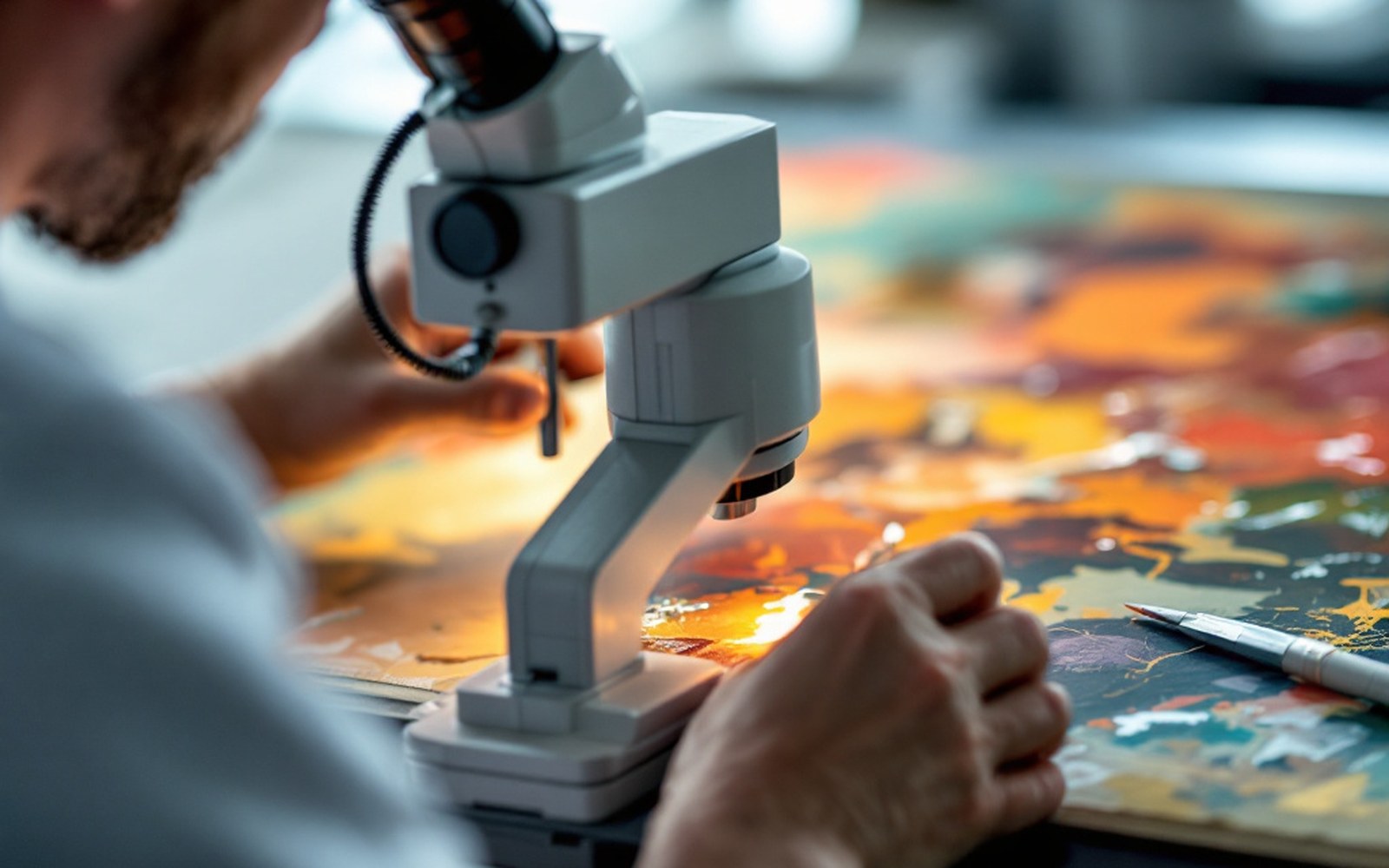
Thread-count analysis has been part of canvas examination for decades, but the method changed character when automated systems replaced manual counting under a microscope.
Scanning the entire picture surface at high resolution, software now counts warp and weft threads across a grid of small tiles and plots the variation across the canvas as a continuous density map. The resulting image can look like a topographic survey: ridges and valleys where the loom's tension fluctuated during weaving.

Those fluctuations are the key. Any bolt of fabric carries a fingerprint — a slowly drifting variation in thread count that no two bolts share. If the same drift appears across two paintings, in the same direction and at the same rate, the canvases almost certainly came from the same piece of cloth.
The method was developed in systematic form by scholars including Don Johnson and C. Richard Johnson Jr., whose computational work on Vermeer and Rembrandt canvases was presented through the Thread Count Automation Project, and its implications for workshop practice have been significant ever since.
For Rembrandt studies, the consequences are concrete. A match between two canvases suggests a shared source — a dealer's stock, a specific supplier, perhaps the bolts held by Hendrick van Uylenburgh's studio on the Jodenbreestraat.
It can corroborate or complicate groupings proposed on stylistic or documentary grounds. Canvas weave mapping does not tell you who painted a picture; it tells you something about where the canvas came from and when, which is a different kind of evidence.
The technique works alongside X-radiography rather than as a replacement. Radiographs reveal changes beneath the surface; weave maps describe the support itself.
Paint cross-sections, ground analysis, and dendrochronology on panel pictures operate in the same layer — physical evidence that neither confirms nor denies an attribution on its own, but that can make some conclusions significantly harder to sustain.
The method was developed in systematic form by scholars including Don Johnson and C.
The practical limit is that canvases are often lined, relined, or trimmed, disrupting the very pattern the method depends on. Even a partial match, though, can be enough to place a picture in a network of related works with a precision that no eye alone achieves.

The practical limit is that canvases are often lined, relined, or trimmed, disrupting the very pattern the method depends on.

