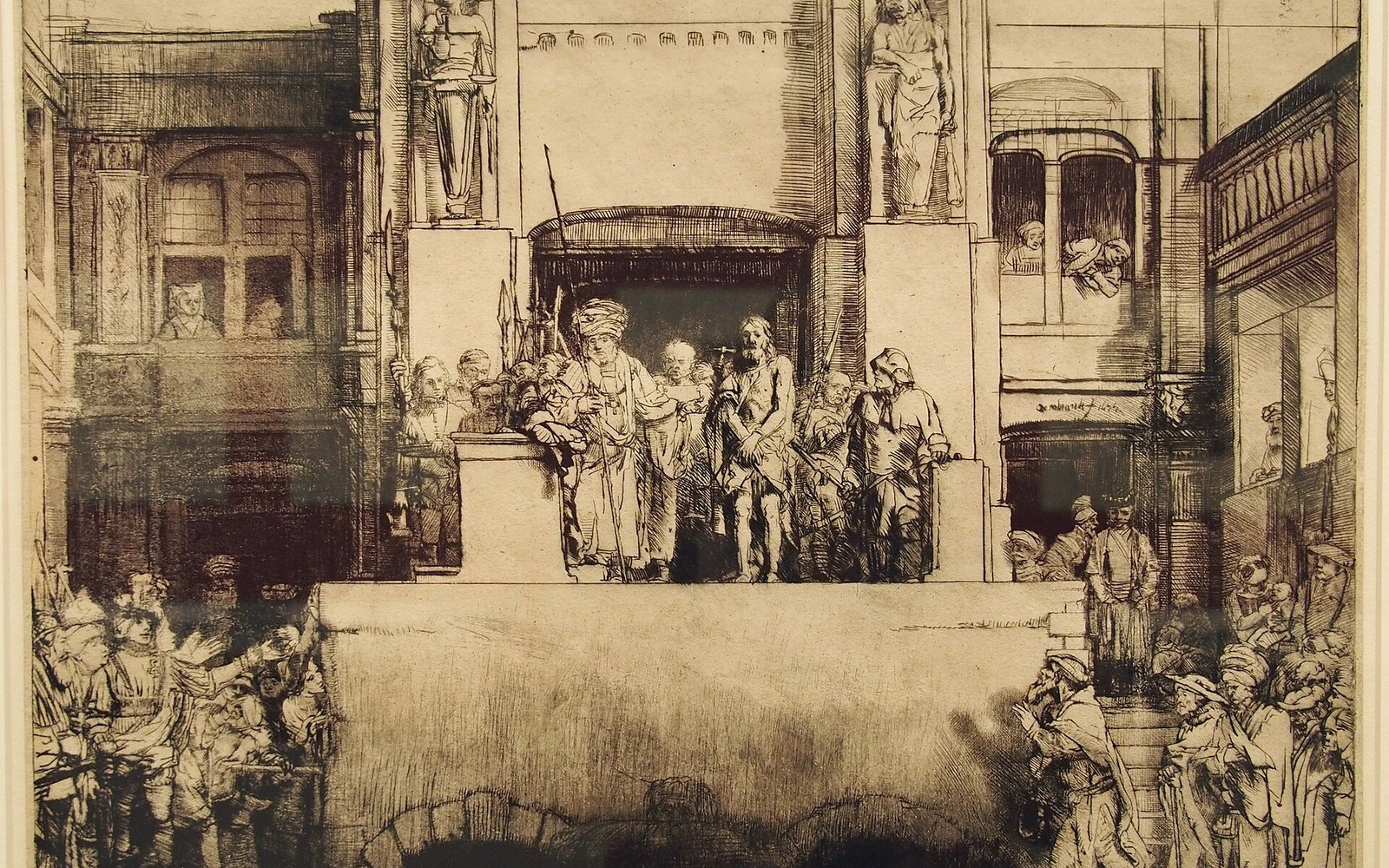
The etching that shrank: how Rembrandt scrapped a crowd and reworked the plate into something harder and stranger.
The Plate and Its States
The large etching known as Christ Presented to the People — or Ecce Homo, from the Latin words Pilate speaks in John 19 — exists in eight states. The plate, which Rembrandt completed in 1655, is one of the largest he ever worked, measuring roughly 358 by 455 millimetres.
That scale allowed him to pack the composition with figures: in the early states, the foreground is occupied by a dense crowd of onlookers, some of them individualized with the care he reserved for etched faces, pressing up beneath the platform where Pilate presents the bound Christ.

The critical move comes between the fifth and sixth states. Rembrandt burnished out the entire foreground crowd — a technical effort of real scale, since burnishing a large area of worked copper flat again, without leaving visible ridges or pits, demands sustained pressure and skill.
In the sixth state, the space those figures occupied becomes a pair of arched niches, each containing a classical figure in low relief, and the middle ground opens into an empty stone floor. The crowd is simply gone. What was a narrative swarm becomes an architectural void.
The effect is disorienting in the best sense: the space below the platform, once jostling and specific, turns abstract and silent, and the isolation of Christ and Pilate above it grows more severe.
Whether this represents a change of iconographic intention or a response to how the plate was printing is not known with certainty. What is clear from looking at impressions of the two phases is that the mood shifts from civic event to something closer to theatre without an audience — which may have been exactly the point.
Drypoint, Burnishing and the Evidence in the Copper
Rembrandt used a combination of etching and drypoint throughout the plate. Drypoint lines carry a burr — a rough lip of displaced copper — that holds extra ink and prints as a velvety richness absent from etched lines alone.
That burr wears fast under the pressure of printing, so early impressions from any given state are warmer and denser than later ones from the same plate. In the states with the crowd, good impressions show the foreground figures with exactly that quality: soft, slightly blurred edges that distinguish them from the sharply bitten architectural and figural elements above.
Drypoint lines carry a burr — a rough lip of displaced copper — that holds extra ink and prints as a velvety richness absent from etched lines alone.
The burnishing that removed the crowd would have had to be thorough enough to eliminate not just the drypoint burr but the etched lines beneath. Copper is forgiving but not infinitely so, and close examination of sixth-state impressions shows slightly uneven tonal areas
where the earlier work was suppressed — a ghost of the previous composition, visible in raking light on the sheet or under magnification, though not reading as image in normal viewing.

Impressions of the early states are held in major print collections including the Rijksmuseum in Amsterdam and the British Museum. The Rijksmuseum's collection record for this print documents multiple states, and comparison between them is the clearest way to follow the revision.
Rembrandt made the same kind of radical between-state transformation on The Three Crosses, where the fourth state amounts almost to a new composition drawn over the old one — but where that plate added darkness and complexity, Christ Presented to the People removes population, and the result is a different kind of strangeness.
The burnishing that removed the crowd would have had to be thorough enough to eliminate not just the drypoint burr but the etched lines beneath.
The plate's survival into later hands meant that posthumous impressions exist, printed after Rembrandt's death in 1669, distinguishable by the further wear of the lines and by the absence of the burr richness that defines the best earlier pulls.
Reading the states in order — against watermarks in the sheets and the physical condition of the lines — is how print scholars have reconstructed the sequence and approximate timing of each intervention.

