
The ridge that makes the velvety black
The needle raises a wall as it cuts
When a printmaker drives a steel or diamond-tipped needle across a copper plate, the metal does not come away cleanly. Alongside the scored furrow, the displaced copper is pushed up into a jagged, irregular ridge — the burr. In intaglio printing, the plate is inked, wiped, and then pressed against dampened paper, which pulls ink out of every incised groove.
The burr, sitting proud of the plate surface, traps ink differently from a cleanly engraved line. It holds a soft, dense deposit at its edge, and when that ink transfers to paper under the weight of the press, it produces the characteristic quality Rembrandt exploited more deliberately and more inventively than any of his contemporaries: a rich, light-absorbing, almost furry darkness that no other technique of his time could replicate.
That quality has a name. Printers and scholars call it the drypoint velvety black — velvety because the burr scatters the ink into something closer to a tone than a line.
Look at an early impression of Rembrandt's Christ Crucified between Two Thieves (the "Three Crosses," B. 78) under magnification and the shadows resolve not into discrete hatched strokes but into a warm, breathing darkness. That effect is not ink in a groove; it is ink caught and released by burr.
Why the burr is also a problem
Copper is soft. The pressure of the press, applied repeatedly over dampened paper, flattens the burr a little each time. In a heavily burred passage, the softness that makes the first impression so seductive is detectable by perhaps the fifth pull, conspicuously altered by the fifteenth, and largely gone after thirty or forty impressions, depending on the depth of the original working and the printing pressure used.
This is not degradation in any defective sense — it is simply the physics of soft metal and mechanical force. But it means that two impressions from nominally the same state of a plate
can look strikingly different, even when no reworking has taken place, and it makes sequencing impressions within a state one of the more exacting tasks in Rembrandt scholarship.
The attrition of the burr is part of why Rembrandt returned to plates to rework them. When a passage of drypoint shadow had flattened, restoring the effect meant applying the needle again, which invariably changed the composition.
The attrition of the burr is part of why Rembrandt returned to plates to rework them.
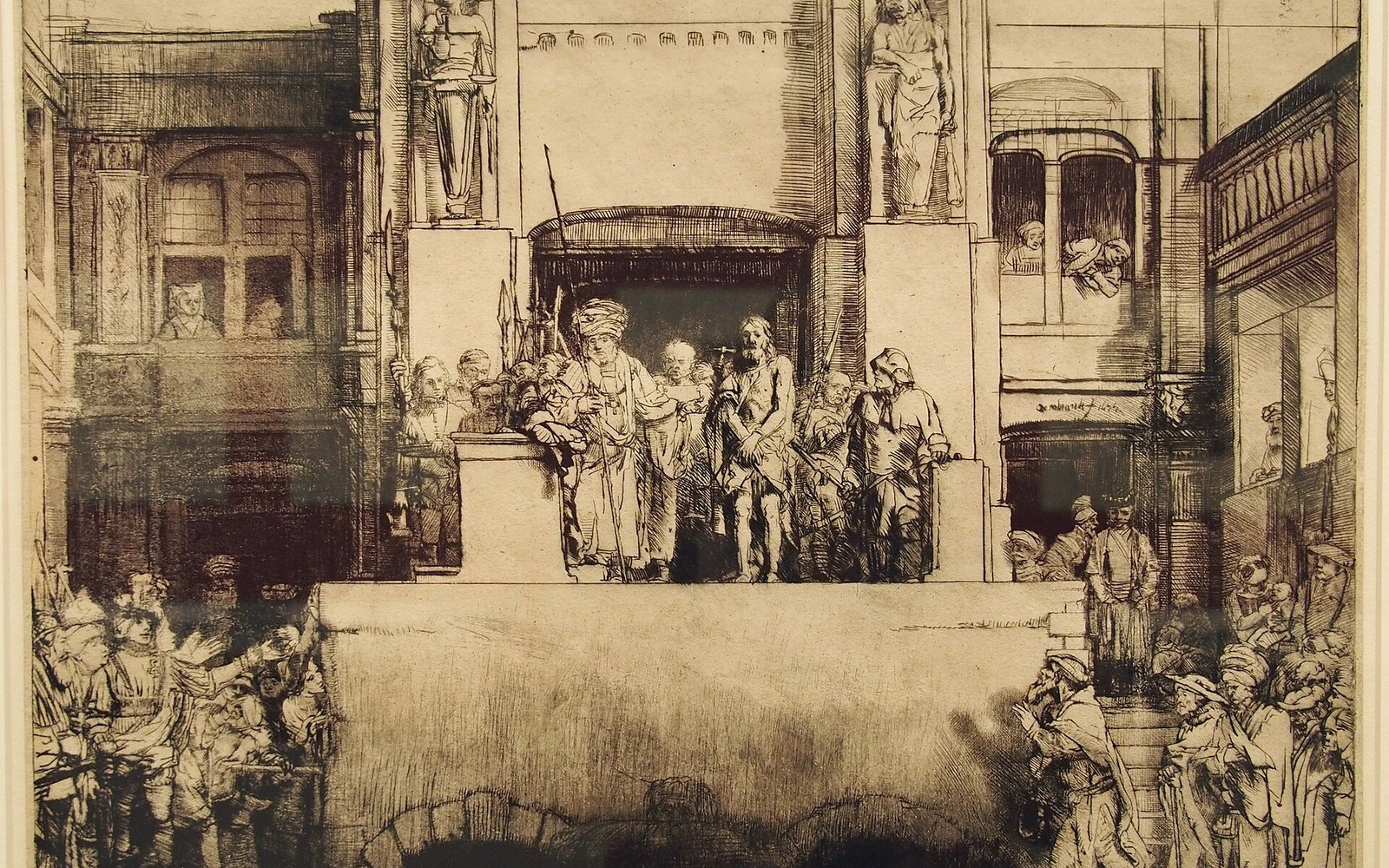
On the Three Crosses, the radical difference between the third and fourth states reflects deliberate revision, but the accumulated loss of burr in earlier states was itself a pressure towards intervention. On Christ Presented to the People (B. 76), a plate reworked so severely that figures were eliminated rather than added, the sequence of wear and renewal is legible in the surviving impressions.
Rembrandt was not working in drypoint alone for most of his career. The great majority of his plates combine etching — in which lines are bitten into the copper by acid, producing a harder, more durable edge — with drypoint passages added at the end, in the dark zones and shadow accents.

The etched lines hold their character through large editions. The drypoint burr deteriorates immediately. A late impression of a combined plate therefore preserves the etched drawing intact while the atmosphere has drained away from the shadows. This combination, and its decay pattern, is one of the primary tools used to date impressions and to distinguish early from later pulls.
Reading burr in scholarship and examination
Scholars who study Rembrandt's prints — work carried out across institutions including the Rijksmuseum print room, the British Museum and the Pierpont Morgan Library — assess burr by direct examination under raking and oblique light, and, for finer analysis, under low-power magnification.
The presence of ink feathering around a line — ink that has spread laterally into the paper fibres from a well-charged burr — distinguishes an early impression from a late one in ways that a facsimile or a photographic reproduction cannot reliably convey.
Watermarks reinforce impression dating but cannot sequence impressions within a short run.
This is why impression quality is inseparable from the physical examination of the sheet, and why the paper itself matters: Rembrandt's use of Japanese paper — a thin, smooth, absorbent import — allowed the burr's ink to transfer with particular completeness, making impressions on it distinctly warmer in tone than those on European laid paper from the same pull.
Watermarks reinforce impression dating but cannot sequence impressions within a short run. Burr assessment does that, however approximately. A Rembrandt print cataloguer working with a group of impressions nominally from the same state must rank them by burr condition, match them against descriptions in earlier catalogue literature, and then consider how each impression's paper, tone and ink density supports or complicates the proposed sequence.

The standard catalogue by Christopher White and Karel Boon in the Hollstein series, alongside the later single-volume work by White, codified much of this methodology; the work of Erik Hinterding at the Rijksmuseum substantially refined the impression sequences and the role of paper in reading them.
No technical method exists for objectively measuring how much burr survives on a printed impression — the burr itself is long since transferred to paper or worn away on the plate; what the scholar reads is the secondary evidence in the ink deposit.
The velvety shadow in an early pull of the Three Crosses is not an artistic effect that later impressions softened: it is a physical material that they lost.
Stereo microscopy and high-resolution imaging have made that reading more precise, but it remains in part a matter of trained visual judgement, the kind that accumulates over years of handling sheets, and that cannot be replaced by remote examination of a reproduction.
Condition and what it means for looking
A heavily burred impression and a worn one from the same plate can appear to be different works, and the uninstructed eye, seeing them in separate rooms or in separate catalogue photographs, has every reason to think so.
The velvety shadow in an early pull of the Three Crosses is not an artistic effect that later impressions softened: it is a physical material that they lost. Knowing this changes the act of looking considerably.

The tonal unity, the sense of enveloping darkness in a strong Rembrandt drypoint, is partly compositional intelligence and partly the presence of copper particles bent up from the plate, holding ink for one or two dozen presses before they give way. That fragility and that richness are the same thing. Every impression is a moment in the life of a piece of metal, and the burr is the part of that metal that changed fastest and gave most.