
Looking beneath the paint without lifting a brushstroke
Infrared radiation passes through most paint layers that visible light cannot penetrate, and what it reaches — the drawing laid down on the ground before painting began — is often the most telling evidence about how a picture was conceived.
For Rembrandt studies, that matters enormously: the underdrawing is where a workshop hand is most easily separated from the master's own preparation, and where changes of mind, called pentimenti, can be read before the picture was committed to its final form.
The technique works because carbon-based drawing materials — black chalk, charcoal, the graphite or carbon-ink that constitutes most underdrawing in seventeenth-century Dutch paintings — absorb infrared strongly, while the lead white and earth pigments of the paint layers above are largely transparent to it.
A detector sensitive to infrared wavelengths captures that differential absorption and converts it to a visible image. The earliest applications, from the 1960s onward, used vidicon tubes sensitive to wavelengths of roughly 0.9 to 2 micrometres.

Later systems moved to indium gallium arsenide (InGaAs) cameras, which extend sensitivity out to around 2.5 micrometres and penetrate thicker, more complex paint builds. For Rembrandt's panels and canvases, which often carry multiple preparatory and paint layers, this extended range matters.
What the reflectogram shows, and what it cannot
A reflectogram is not a photograph of the underdrawing: it is a map of infrared reflectance across the picture surface. Where carbon-based marks are present, the image goes dark; where the ground and paint are transparent to infrared, it stays light.
The result can reveal confident, sure-handed brushwork sketched directly onto the ground — the kind of free, gestural preparation associated with lead white and impasto passages in Rembrandt's finished surfaces — or it can reveal careful, hesitant underdrawing laid in with a finer tool, suggesting a different kind of preparatory practice or a different hand altogether.
In Rembrandt's own pictures, underdrawing is often sparse or absent. Many paintings appear to have been begun directly with a brush loaded with dilute paint — a fluid compositional sketch in monochrome rather than a drawn outline.
The Anatomy Lesson of Dr Nicolaes Tulp at the Mauritshuis, examined with infrared, shows how the figure group was adjusted in position and in the placement of individual sitters before the final paint was applied. That kind of large compositional revision, visible in the reflectogram as ghost forms overlaid by the final image, is characteristic of a painter thinking with a brush.
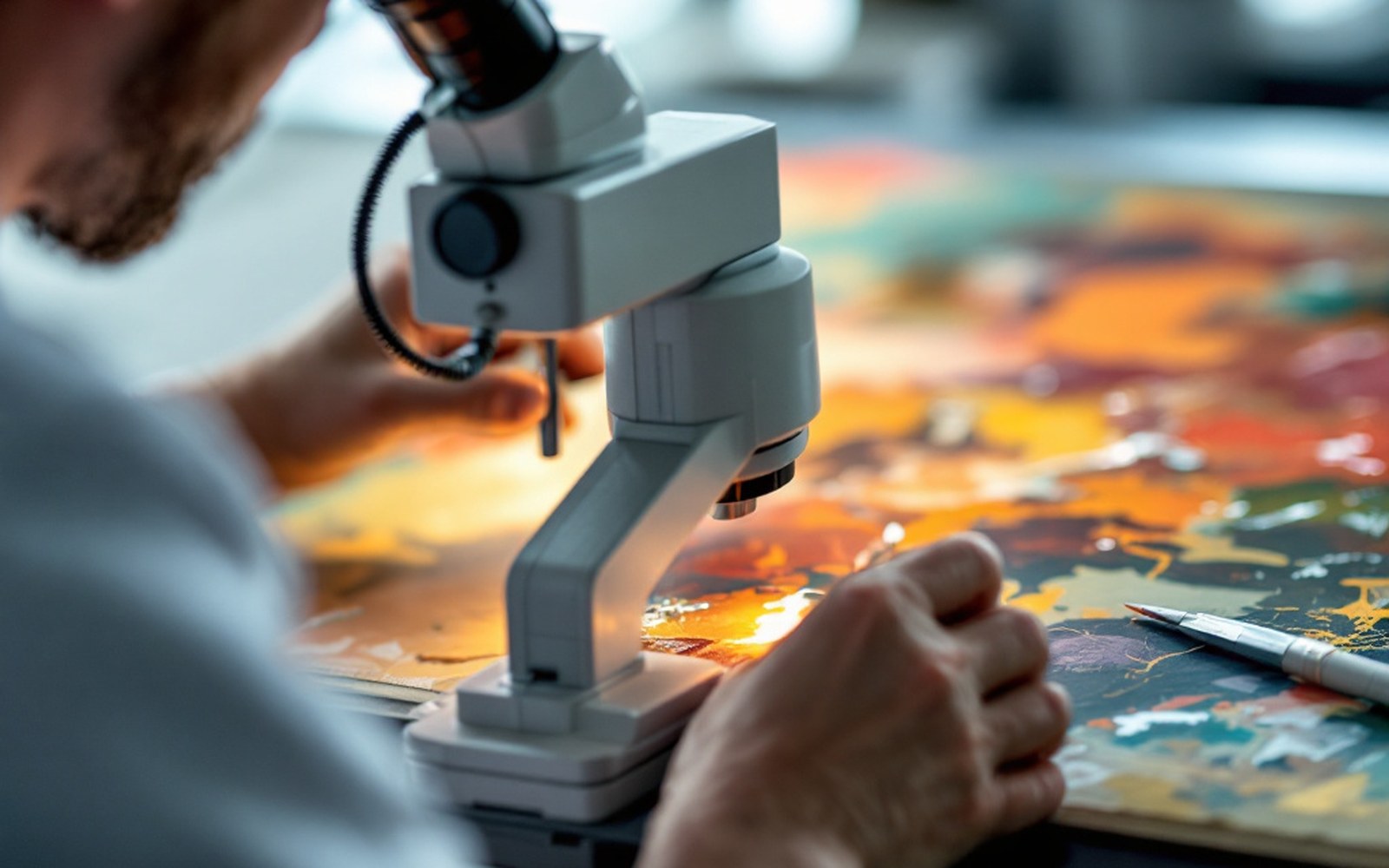
Where reflectography has been most productively applied in the Rembrandt corpus is in distinguishing workshop practice. Pupils at different stages of training used different preparatory methods.
Gerrit Dou, who worked in a meticulously layered technique, left underdrawings consistent with that laborious method. Paintings attributed to Ferdinand Bol or Govert Flinck in their Rembrandtesque phase show underdrawing habits that can sometimes be mapped against known autograph examples, supporting or complicating attributions.
One limitation is consistent across all infrared work: the technique is blind to underdrawing made with materials that do not absorb in the infrared range.
The technique cannot on its own declare authorship — no single examination method can — but it adds a strand of technical evidence that sits alongside paint cross-sections, dendrochronology of the panel and X-radiography.
One limitation is consistent across all infrared work: the technique is blind to underdrawing made with materials that do not absorb in the infrared range. Iron gall ink, widely used in seventeenth-century drawing, is frequently transparent to infrared and leaves no trace in the reflectogram.

An absence of visible underdrawing does not, therefore, mean no underdrawing was made. Equally, smalt — the cobalt-bearing blue glass used in many Dutch paintings — becomes partially transparent to infrared as it degrades, which can produce reflectograms that look through the paint in ways that complicate the reading. The examination of smalt passages always requires corroboration.
The reflectogram as a mosaic, and how the field developed
Until the late 1990s, reflectography was necessarily a mosaic process: the detector's field of view was small, and a full image of any reasonably sized panel required dozens of individual captures to be assembled by hand.
Misalignment, variation in lighting across the picture surface and slight differences in distance between captures all degraded the composite. The Rembrandt Research Project, which operated from 1968 to 2011, incorporated reflectography into its examination programme alongside X-radiography and dendrochronology, but it worked with the mosaic method throughout most of its run.
Misalignment, variation in lighting across the picture surface and slight differences in distance between captures all degraded the composite.
The published volumes of A Corpus of Rembrandt Paintings reproduce many of those composite reflectograms, and their quality varies considerably between the earlier and later volumes.
The development of large-format InGaAs scanning systems — notably the OSIRIS system — allowed whole-picture, high-resolution reflectograms to be captured in a single pass by the mid-2000s.

The Rijksmuseum's technical laboratory applied comparable high-resolution methods to the Night Watch and other large canvases, with results detailed in its ongoing Operation Night Watch research. The Cultural Heritage Agency of the Netherlands has used similar systems as part of broader surveys of Dutch Golden Age material.
What a high-resolution whole-picture reflectogram changes is the readability of texture and handling. Individual brushstrokes in the underdrawing become legible as strokes rather than as tone, and the direction, pressure and sequence of marks can be compared across pictures at a level of detail that the mosaic method obscured.
For the study of workshop practice, this is not a minor refinement: it is the difference between reading the character of the preparatory work and merely noting its presence.
For the study of workshop practice, this is not a minor refinement: it is the difference between reading the character of the preparatory work and merely noting its presence.
The National Gallery in London has published reflectogram details for several Rembrandt paintings in its collection as part of its technical research on paintings in its collection, and the RKD — Netherlands Institute for Art History holds documentation from many technical campaigns on Dutch seventeenth-century paintings, including reflectogram archives associated with the Corpus volumes.

None of this makes the reflectogram self-interpreting. A free, confident underdrawing associated with an autograph picture is useful evidence; it is not proof. The same underdrawing habits, once established, could be learned by a pupil. What infrared reflectography delivers is not an answer but a question made visible: the question of how a picture began, and whether the hand that began it was also the hand that finished it.