
The pigment that makes sculpture out of paint
Rembrandt's thickest passages are not decoration. Where a highlight sits on the bridge of a nose, a pearl catches candlelight, or a cuff falls against a dark sleeve, the paint is piled up into a ridge that casts a genuine shadow on the canvas beside it — a physical thing, not an illusion of one.
The mechanics behind this depend almost entirely on a single material: lead white, the primary white pigment of seventeenth-century European painting and the only common pigment of the period with the body to hold a loaded brushstroke in three dimensions without slumping back into the ground.
Lead white is basic lead carbonate, manufactured by corroding lead sheets in acetic acid vapour — the so-called stack process — and then grinding the resulting crust to a powder. Mixed with linseed oil, it produces a dense, brilliantly opaque paste with an unusually fast drying time, because lead ions catalyse the oxidative polymerisation of the oil binder.
The result is a paint that stiffens quickly enough to preserve the shape left by the brush or palette knife. In thin layers it glazes; in thick ones it builds relief. No other pigment in the seventeenth-century palette behaves this way at this extreme.

Smalt, the cobalt-containing blue glass ground fine for painters' use, handles very differently; chalk or lead white mixed with other pigments quickly loses the same knife-edge sculptural quality. Lead white alone can carry this burden because it is lead white alone — uncut, heavily loaded, sometimes worked almost straight from the mulling stone.
How the impasto is built
X-radiography reveals what is invisible to the eye: beneath finished surfaces, lead-white-rich underlayers that form a complete tonal scaffolding before the final strokes are applied. Because X-radiography reads lead density, not colour, the radiograph of many Rembrandt paintings shows a startlingly bright, almost independent composition in which the highlights are already fully committed.
The artist worked out mass and light in opaque, lead-heavy paint first, then modified colour and detail in upper layers. When those upper layers include thin glazes — often organic reds or blacks over the pale ground — the total depth of the surface combines physical height with optical depth, one literal and one illusory, working together.
The palette knife, not just the brush, plays a documented role. Paint cross-sections taken from several works show upper strata with flat, compressed edges characteristic of a blade rather than a bristle — the pigment particles are aligned, the layer boundary is sharp.
A brush leaves a rounded, tapering edge and a striated surface under magnification; a knife leaves a cliff face. Raking light photographs, in which a lamp is held nearly parallel to the picture surface, reveal these ridges clearly: impasto in the highest highlights may stand well above the surrounding paint film, casting measurable shadows that shift as the light angle changes.
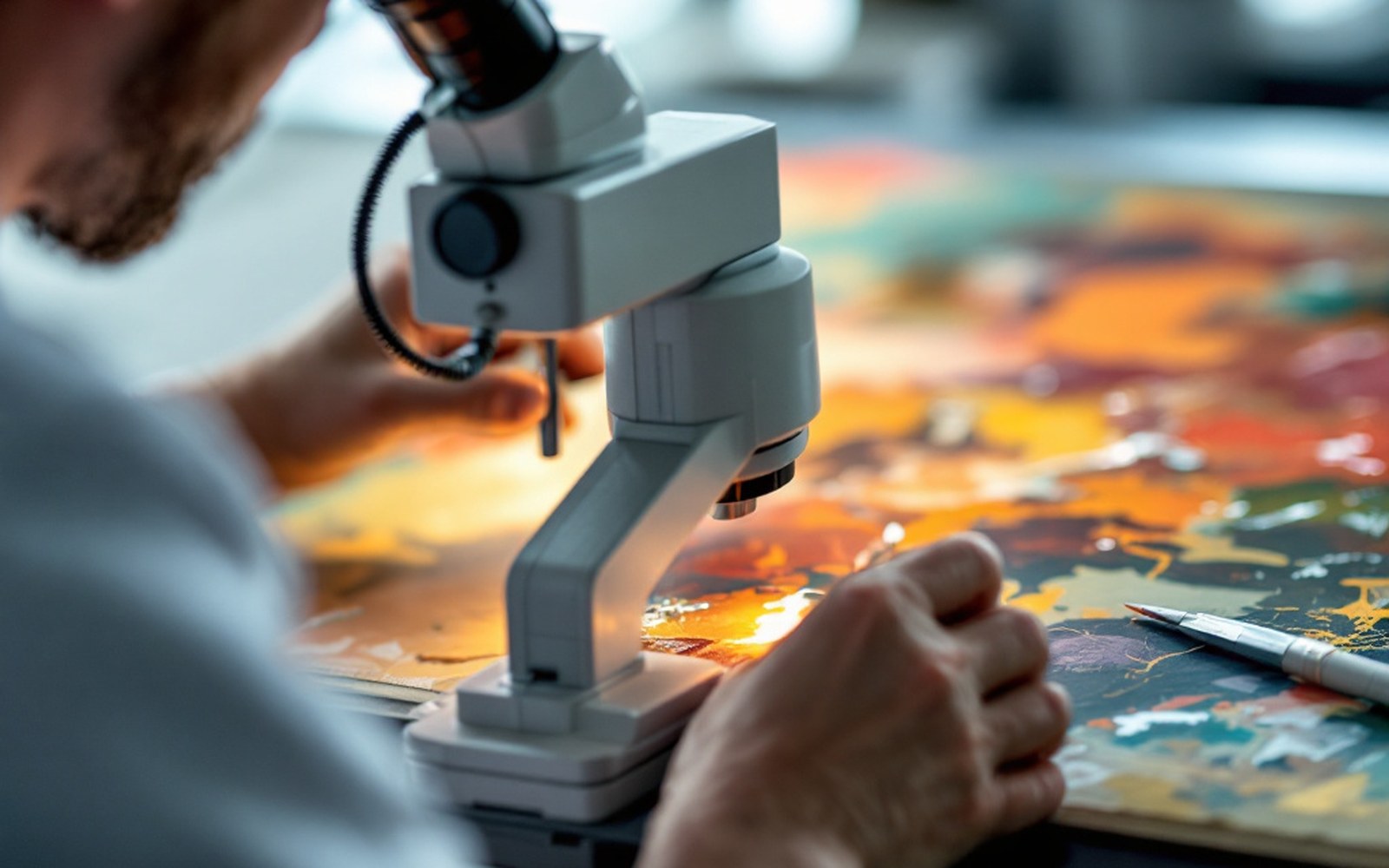
Some of the luminosity in the painted jewels and saturated whites is therefore real luminosity — scattered light from a three-dimensional surface, not paint mimicking it.
Material consequences and ageing
Lead white's virtues carry costs. Over time, the oil-lead system can saponify: lead ions in the drying film react with fatty acids in the oil to form lead soaps, which can migrate through the paint layers and emerge at the surface as pale, waxy protrusions — a condition distinct from the intended impasto and one that has been documented in a number of Dutch seventeenth-century paintings examined under high-magnification cross-section.
The Cultural Heritage Agency of the Netherlands and several museum conservation departments have published analytical work identifying this process in pictures from the period.
Craquelure — the network of cracks that develops as a paint film ages and becomes brittle — behaves differently in thick impasto than in thin paint.
Craquelure — the network of cracks that develops as a paint film ages and becomes brittle — behaves differently in thick impasto than in thin paint. A heavily loaded passage may crack in a characteristic pattern, sometimes following the ridges of the original brushstroke, sometimes opening at right angles to them.
Because lead white dries from the surface down, differential shrinkage between the fast-drying skin and the slower interior can initiate cracking that propagates over decades or centuries. Restorers working on heavily impasted pictures must account for the mechanical fragility of these raised passages; old fills and retouches in impasto areas are often visible in raking light precisely because they cannot exactly replicate the original surface topography.

Identifying the hand
The density and character of impasto is one of the markers that has been used — carefully, and never in isolation — to discuss workshop participation. Rembrandt trained several pupils who became highly capable painters: Govert Flinck and Ferdinand Bol among them, both of whom produced work close enough to their teacher's that attribution has shifted more than once.
In technical examinations conducted as part of the Rembrandt Research Project, which ran from 1968 to 2011, the character of impasto passages was considered alongside dendrochronology, thread counts, ground composition and underdrawing when assessing whether a given picture was likely to have been produced by the master or by a workshop hand.
The interface between layers can show whether the upper strokes were applied wet-into-wet — which pulls and intermixes — or onto a dry surface.
The project's published conclusions, set out across five volumes of A Corpus of Rembrandt Paintings, engaged repeatedly with this question, and the answer was never simple: a workshop assistant who had spent years watching and assisting could approximate the outer appearance of thick impasto without replicating the underlying decision structure — the way the ridge is set down in one committed motion rather than built cautiously in stages.
Paint cross-sections are the most direct evidence here. A sample from a genuine highlight in a securely attributed picture shows a characteristic sequence: a quartz- or chalk-containing ground, a mid-tone underlayer, a thicker lead-white-rich intermediate, and a final stroke that may be almost pure pigment.

The interface between layers can show whether the upper strokes were applied wet-into-wet — which pulls and intermixes — or onto a dry surface. Wet-into-wet working in the highlights is consistent with a painter confident enough to work quickly and directly; the alternative approach is visible and tells a different story.
Lead white is also a primary subject in X-ray fluorescence mapping of Rembrandt's works held at major institutions, since its elemental signal is strong and unambiguous.

Mapping lead distribution across an entire canvas surface, rather than relying on a single cross-section, gives a spatial picture of how the impasto is distributed — concentrated along contours, massed in primary highlights, thinning toward shadow passages — that can be compared across groups of pictures when questions of attribution or dating are under discussion.
The ridge on the cuff, the loaded stroke across the pearl: these are not flourishes. They are the product of a pigment chosen for its physical properties and a handling method calculated to extract the most from them.