
The wood behind the paint
Most of Rembrandt's smaller and mid-sized paintings on panel rest on boards of Baltic oak — Quercus robur felled somewhere in the forests of what is now Poland, floated west along the rivers Vistula and Oder, and shipped through Danzig (Gdańsk) to the ports of Holland.
This timber had been the preferred support for Netherlandish panel paintings since the fifteenth century, and the reasons were largely practical. Baltic oak grows slowly in a continental climate, producing rings that are narrow and even, giving a dense, stable grain.
The Amsterdam timber trade was one of the largest in Europe throughout the seventeenth century, so Rembrandt's contemporaries could buy well-seasoned boards without difficulty. By contrast, German or local oak, with its wider and more irregular rings, was considered inferior and rarely chosen.
A panel painter's supplier was not a carpenter but a specialist guild member: in Amsterdam, the Guild of St Luke regulated the preparation of panels. Boards were typically quarter-sawn — cut radially from the log rather than tangentially — because quarter-sawing exposes the medullary rays, those bright silvery lines visible in unprimed oak, and produces a surface that moves less dramatically with changes in humidity than flat-sawn timber does.
Even so, a single plank wide enough for a large composition was unusual, and most of Rembrandt's panels are made from two or three boards joined vertically with butt joints or, occasionally, tongue-and-groove.

Dendrochronology, the ring-counting method applied systematically to Rembrandt's panels from the 1970s onward, can identify when a given board was felled and whether two panels were cut from the same tree — evidence that has proved useful in establishing whether a work could have been painted at a claimed date at all.
Once joined, the panel was planed on both faces to a working thickness that could be as little as four or five millimetres in the smallest cabinet pictures and might reach fifteen or more in larger works.
The front face received a ground — often chalk-and-glue in early Dutch practice, though quartz grounds appear in Rembrandt's work too — and the back was sometimes sealed with a coat of paint or glue size to even out moisture exchange from both sides. Whether that back coating was applied consistently or carefully is another matter; the evidence from surviving panels is uneven.
How panels move, and what was done about it
Wood is never inert. It expands across the grain when humidity rises and contracts when the air dries, and it does so in one direction with considerably more force than any adhesive or superimposed paint layer can resist.
A joined panel with grain running in different directions across its boards is particularly prone to opening or stepping at the join. Early collectors, seeing cracks develop or hearing panels creak, turned to restorers; and restorers, from the eighteenth century onward, turned to the cradle.
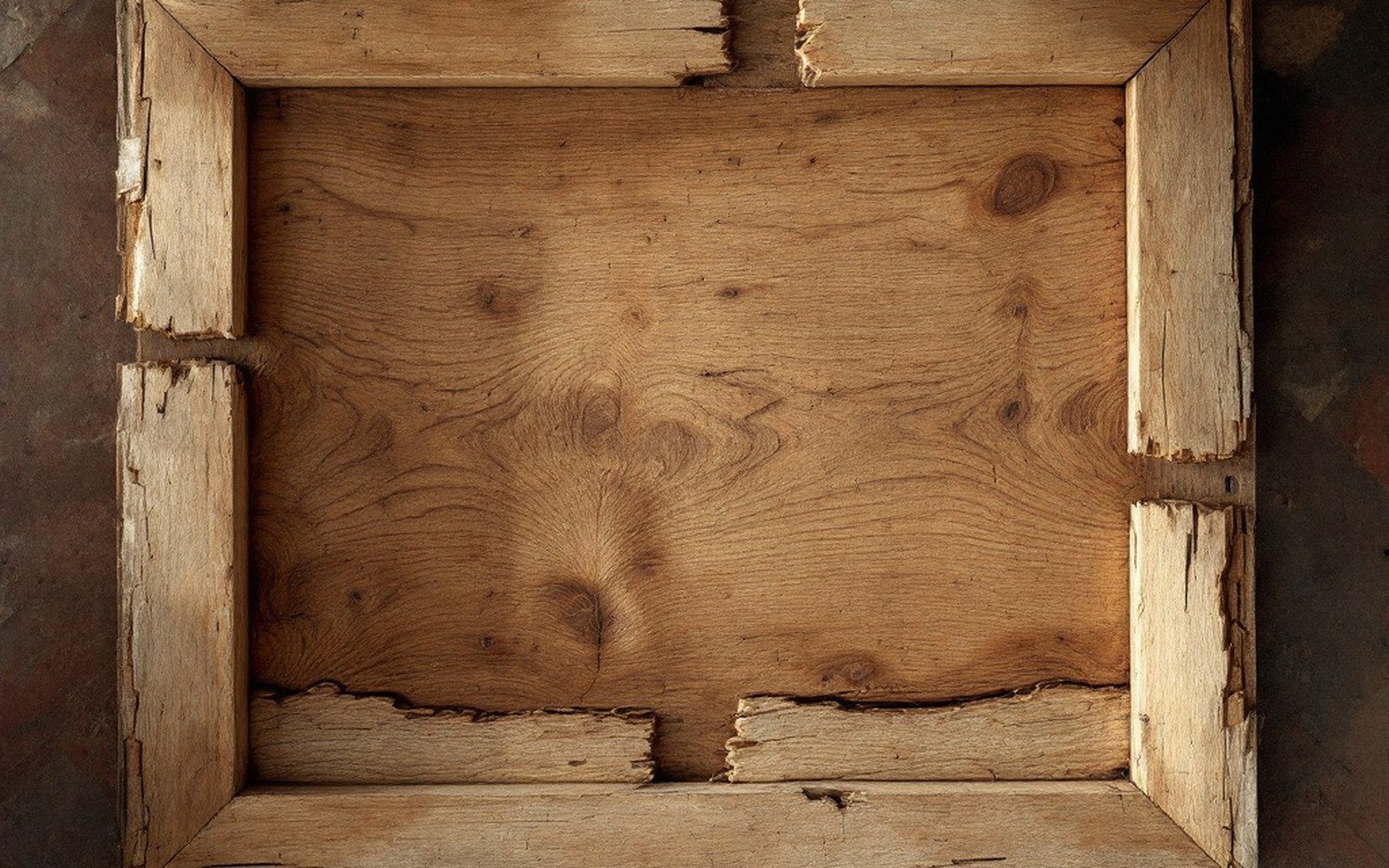
A cradle is a lattice of strips — usually oak or walnut — glued in one direction parallel to the grain of the panel and threaded through perpendicular sliding members that are left free to move. The theory is coherent: the fixed strips run with the grain, the floating crossbars are supposed to slide in their channels as the panel breathes, and the whole assembly is meant to allow natural movement while preventing warping.
In practice the system has a poor record. The crossbars bind. The adhesive used to fix the fixed strips to the back of the panel applies an uneven restraining force that introduces new stresses the panel was not under before.
Early collectors, seeing cracks develop or hearing panels creak, turned to restorers; and restorers, from the eighteenth century onward, turned to the cradle.
Moisture exchange through the back of the panel is altered dramatically — and not always beneficially — by the mass of wood glued to it. The result, documented in panel after panel examined over the past half-century, is that cradling frequently causes or accelerates the cracking it was meant to prevent.
Rembrandt's panels arrived in their worst condition not simply because they were old but because they were cradled aggressively during the eighteenth and nineteenth centuries, when large numbers of Dutch and Flemish pictures passed through Paris or London restorers' studios.

Some were also thinned — planed from behind to a fraction of their original thickness before the cradle was applied, a procedure intended to give the restorer more control but which left the paint layers with almost no structural backing beyond the lattice itself. Where cross-sections through the ground and paint survive, the Cultural Heritage Agency of the Netherlands and conservation departments at the Rijksmuseum and the National Gallery, London, have used them to assess how much original substrate remains.
Reading the damage, reading the structure
X-radiography is the primary tool for seeing through Rembrandt's paint layers to the wood below, and it reveals the grain of the panel, the position of the joins, and the craquelure patterns that follow both.
Cracks in paint rarely run at random: on oak panels they tend to follow the early wood (wider, softer growth rings) and to open or close as the board breathes across the seasons. A radiograph showing a step at a join, or a fan of cracks radiating from a knot, tells the conservator exactly where the structural problem lies before any paint is touched.
A radiograph showing a step at a join, or a fan of cracks radiating from a knot, tells the conservator exactly where the structural problem lies before any paint is touched.
Raking light photographs, taken with a lamp almost grazing the surface, make the same distortions visible as topography — the slight humps and depressions above each board in a joined panel, the ridges thrown up where the paint film has moved against an immovable cradle member beneath.
These surface deformations matter because they affect the reading of paint handling: a passage that looks like heavy impasto may partly be a panel distortion pushing paint up from below.

The scholarly record of individual panels has grown considerably since the Rembrandt Research Project — which operated from 1968 to 2011 — made systematic technical examination the foundation of its attribution work.
Each volume of the Corpus of Rembrandt Paintings included support descriptions: board count, join type, grain direction, approximate thickness, and cradle condition, recorded at the time of examination. That data now allows the Netherlands Institute for Art History to compare panels across the oeuvre with a consistency earlier scholarship could not achieve.
What that comparison shows is that the panels themselves carry as much historical information as the paint.
What that comparison shows is that the panels themselves carry as much historical information as the paint. A board whose rings, read through dendrochronology, indicate felling no earlier than a certain year sets a hard lower bound for the picture's date.
The character of the join, the thickness of the ground, the presence or absence of a back coating — these are not peripheral details. They are the structure on which everything visible depends, and understanding how that structure has changed over four centuries, between restorers' benches from Amsterdam to Paris to London, is inseparable from reading the picture at all.
