
How a lamp held almost flat to the surface tells the picture's physical story
A single lamp moved to within a few degrees of parallel to the painted surface transforms a painting from an image into a relief map. Where diffuse gallery lighting hides everything textural, raking light makes impasto ridges cast their own tiny shadows, reveals old craquelure running across a glaze, and shows retouching, overpaints and canvas deformations that are invisible under any other ordinary examination condition.
The method needs almost no apparatus. In practice, a movable tungsten or LED source is positioned well to one side of the picture, low enough that its beam grazes the surface rather than illuminating it frontally.
A camera records what the eye already sees: the micro-relief of the paint surface thrown into strong shadow-and-highlight. The lower the angle, the more extreme the topography appears. Conservators typically work a source around the full perimeter — left, right, top, bottom — because a ridge running parallel to the light direction will be invisible at one angle and emphatic at another. Doing all four passes catches the full texture map and ensures that nothing is missed.

What it shows
Impasto is the most obvious beneficiary. In a painting like Bathsheba at Her Bath, where the paint is built into standing ridges and the surface reads almost as sculpture, raking light confirms the sequence of marks and the direction of brush strokes that built each form.
The thick white preparation of a highlight, the blunt-edged scraping of a shadow passage, the final thin glazes pooled in the troughs — all of these read differently under raking illumination than under standard lighting, and the resulting photographs become part of the technical record.
Craquelure patterns also resolve sharply. Age cracks in old paint form along lines of stress in the ground or support beneath; their width, depth and distribution are diagnostic. A crack that stops at a paint boundary can indicate a later addition; one that continues uninterrupted across two adjacent passages suggests both were painted at the same time.
Raking light photographs showing crack networks appear regularly in the published volumes of A Corpus of Rembrandt Paintings, where they are used alongside X-radiography and paint cross-sections to build the physical argument for or against workshop autograph status.
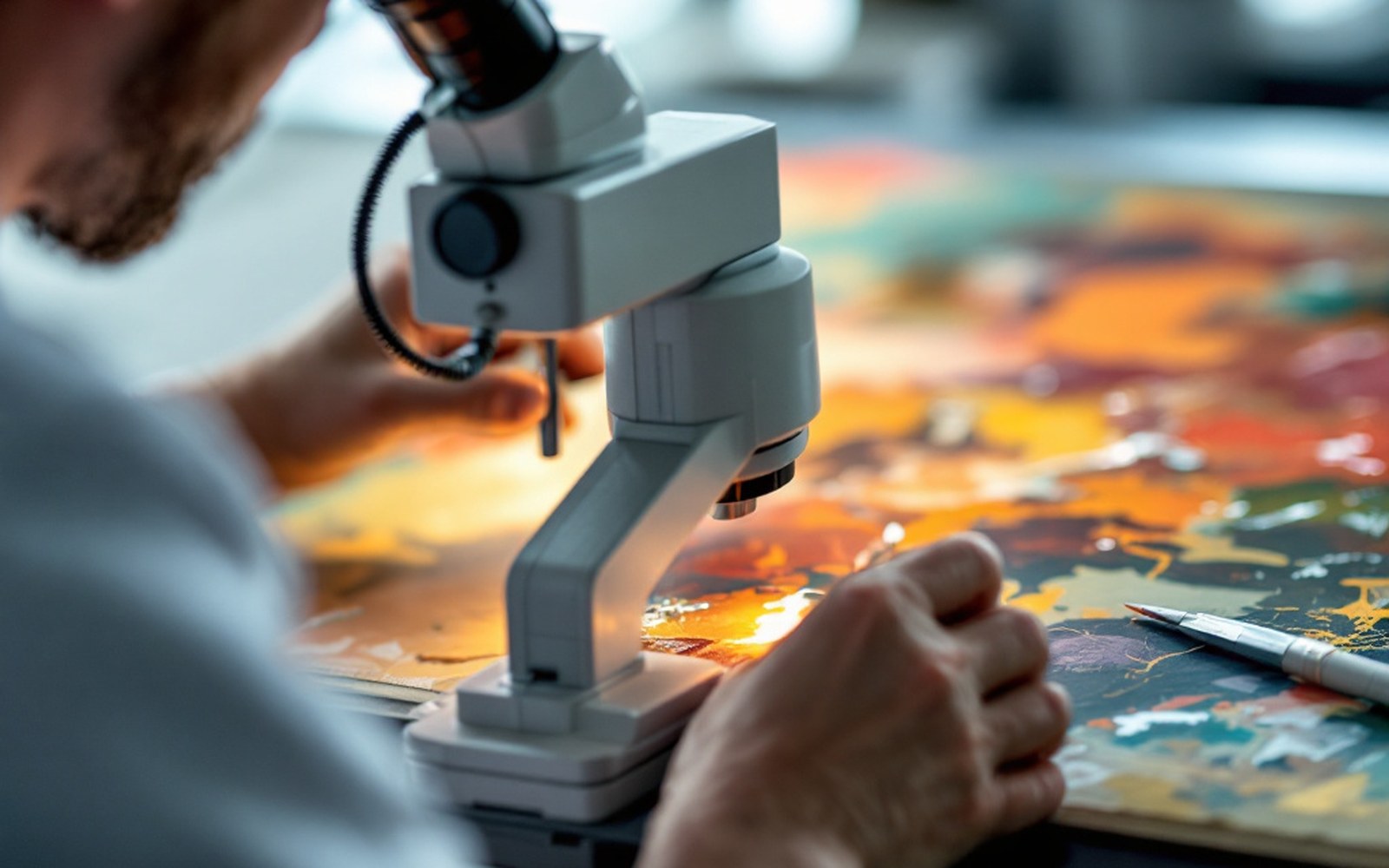
Condition damage and old restorations are equally legible. A retouched loss, even one well matched in colour, will sit at a slightly different surface level than the surrounding original paint — it was applied over a filled channel and behaves differently in the drying.
Under raking light that micro-step in the surface becomes plainly visible. Tear repairs on canvas, flattened impasto from past lining pressure, and later additions from restoration campaigns show up without any chemical intervention and without touching the object.
Age cracks in old paint form along lines of stress in the ground or support beneath; their width, depth and distribution are diagnostic.
Canvas deformations — dents, draws at the tacking margins, old nail holes, undulations across the whole composition — become readable as topographic events rather than visual distractions. Comparing raking-light photographs taken decades apart can show whether a deformation is stable or progressing, which informs decisions about structural treatment.
The method and its limits
Raking light is non-invasive and instantaneous; that is its chief virtue. Technical photography in conservation has standardised procedures for recording angle, distance and light colour so that photographs made at different institutions can be compared.
The Cultural Heritage Agency of the Netherlands and the Rijksmuseum both use raking light as a routine first pass in any technical study of a Rembrandt-attributed panel or canvas, precisely because it costs nothing in risk to the object and produces immediately legible results.

Its limits are real. Raking light reads surface; it cannot see through paint. It will not reveal an underdrawing, distinguish lead white from chalk in a ground, or identify a pigment.
For those questions the examination moves on to infrared reflectography, X-radiography and paint cross-sections. Raking light comes first — a quick, low-stakes overview that sets the agenda for everything that follows.
It will not reveal an underdrawing, distinguish lead white from chalk in a ground, or identify a pigment.

