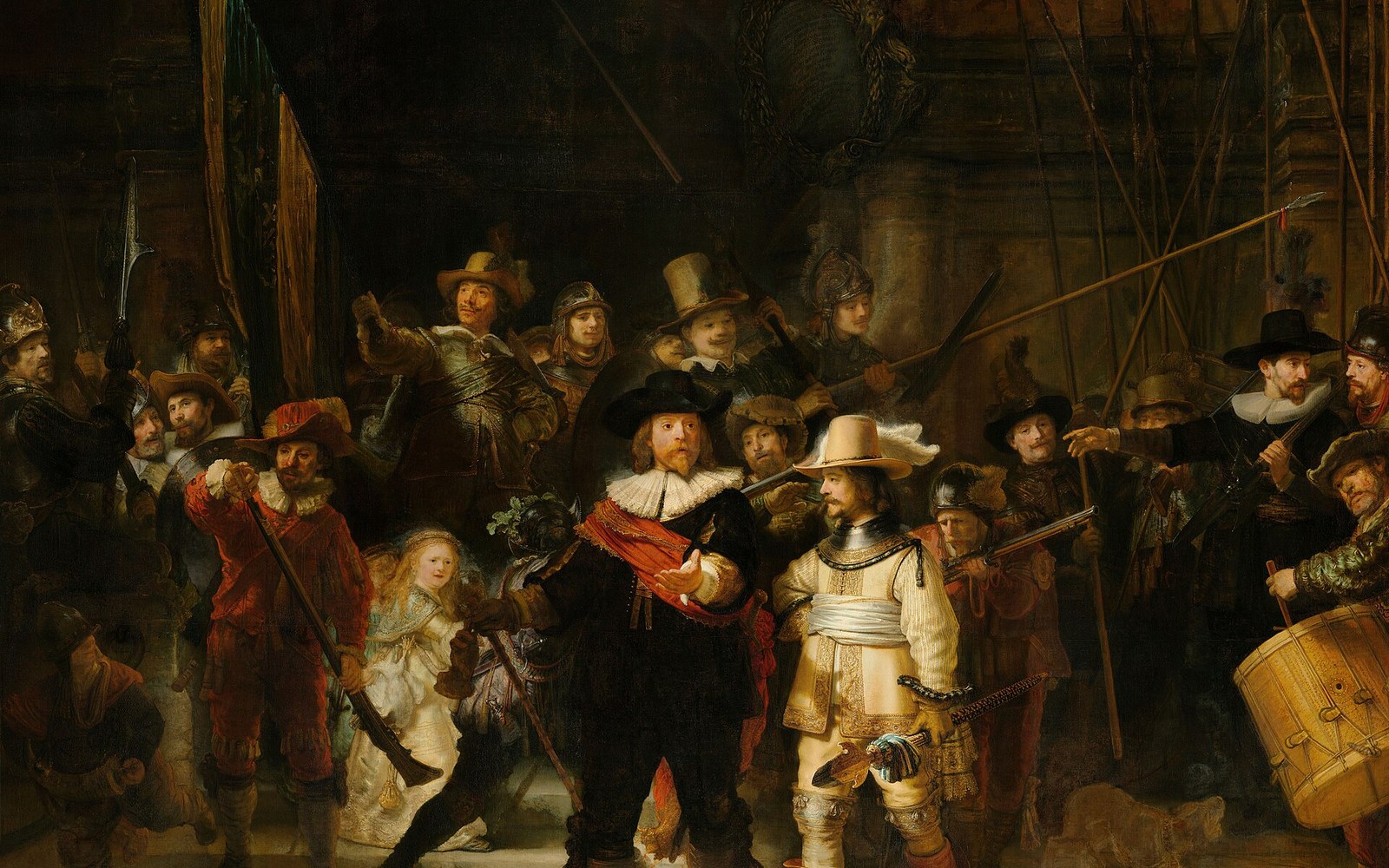
The most examined painting in the Dutch canon is also the most physically compromised — stripped of its edges, cleaned twice in public and stabbed by visitors on three separate occasions.
The Object and Its Injuries
Rembrandt completed the painting in 1642, signing it on the shield that hangs above the main archway: Rembrandt f. 1642. The commission came through the Kloveniersdoelen, Amsterdam's civic hall for the musketeers' guild, and the picture was one of six large group portraits installed in the Great Hall there, each recording a company of the city's militia.
Rembrandt's shows Captain Frans Banninck Cocq in black and his lieutenant Willem van Ruytenburch in yellow leading a company of arquebusiers into motion — or, more precisely, shows what appears to be motion captured at an instant, which was itself a departure from the static arrangement most militia portraits offered.

The support is canvas, not panel, which by 1642 was standard for a painting of this scale. The canvas is mounted on a large strainer, and canvas weave analysis conducted during the 1975–1976 conservation campaign confirmed the weave structure consistent with mid-seventeenth-century Amsterdam linen.
The ground is a double layer, a reddish-brown earth preparation under a lead-white-bearing upper ground, a combination well documented in Rembrandt's work of the 1630s and 1640s.
The picture's most consequential physical event happened not to the paint surface but to the support itself. When the painting was moved to the Amsterdam Town Hall on the Dam in 1715, it was cut down on all four sides to fit its new location. The loss was greatest on the left edge, where a strip wide enough to contain two full figures was removed.
A copy made around 1650 by Gerrit Lundens, now in the National Gallery in London, preserves the composition before the cut; using that copy as a control, scholars have been able to reconstruct the original dimensions and identify the missing figures — an older man and a boy — that stood to the left of Banninck Cocq's company. The painting as it exists today is approximately 363 by 437 centimetres; the original was meaningfully wider and slightly taller.

Layers, Light and What Lies Beneath
The paint handling throughout is characteristic of Rembrandt's middle period: a warm impasto in the lit passages — Van Ruytenburch's lemon-yellow costume is built up with loaded strokes of lead white mixed with lead-tin yellow — set against thinner, more fluid darks where glazes of umber and black carry much of the shadow.
The girl in the middleground, who carries a dead chicken at her belt (its claws reading as the badge of the Kloveniers), is picked out in bright ochre and white in a way that makes her legibility from a distance almost diagrammatic. Whether she is an allegorical figure, a guild emblem in human form or simply a compositional device has occupied writers for generations without resolution.
X-radiography showed that Banninck Cocq's extended left hand was repositioned during painting; it was originally placed slightly lower, closer to his body.
Infrared reflectography carried out during the 2019–2021 Operation Night Watch examination, led by the Rijksmuseum in collaboration with the Cultural Heritage Agency of the Netherlands, revealed underdrawing in the principal figures consistent with Rembrandt's own hand — rapid, functional lines establishing the positions of the arms and the fall of the cloak — rather than the more mechanical transfer underdrawing associated with assistants.
X-radiography showed that Banninck Cocq's extended left hand was repositioned during painting; it was originally placed slightly lower, closer to his body.
Raking-light examination of the surface makes visible the long craquelure network typical of this scale of canvas, and also shows the three knife cuts inflicted by a visitor in 1975.
Those cuts were repaired in the conservation campaign that immediately followed, and the repairs are detectable under close examination but do not obscure reading at normal viewing distance. An earlier knife attack in 1911 and a further acid attack in 1990 were both treated by the museum's conservation department; the 1990 damage was relatively superficial and the repairs consolidated quickly.

The varnish history is substantial. Multiple campaigns of old varnish removal and reapplication across the eighteenth and nineteenth centuries have left the surface somewhat uneven in gloss, and the colour relationships now visible are not exactly those Rembrandt intended — a problem common to large pictures with complicated restoration histories.
The Scholarship and the Examinations
The painting entered systematic technical scholarship relatively late. Abraham Bredius published on it; Cornelis Hofstede de Groot catalogued it in his survey of Rembrandt's paintings. But the large-scale physical examination began only with the Rijksmuseum's 1975–1976 restoration and the publications that followed, which established the stratigraphy — ground, underlayers, paint and later additions — in usable detail.
The Rembrandt Research Project, which operated from 1968 to 2011, treated the Night Watch as securely autograph from an early stage; the project's conclusions on the painting, published in the Corpus of Rembrandt Paintings, volume III (1989), summarise the technical findings available at the time and confirm the attribution on both stylistic and material grounds.
The copy is held in the National Gallery's collection and was itself examined technically to assess how faithfully it records Rembrandt's original surface.
The Corpus entry also notes the degree to which the cuts of 1715 complicate any complete account of the composition.
The most comprehensive examination to date is Operation Night Watch, which ran from 2019 to 2021 and used macro X-ray fluorescence scanning to map the distribution of pigments across the full surface — one of the largest applications of the technique to a single work at that point.

The results confirmed the presence of smalt in the sky passage at upper right, now significantly degraded and grey where it was once blue; lead white and lead-tin yellow in the costume passages; and vermilion in the drum at lower right. The scan also revealed a blocked-in figure in the background, behind the main group, painted over during Rembrandt's own working process rather than added or obscured by a later hand.
The Lundens copy at the National Gallery is not a minor curiosity but a primary document. Because it predates the 1715 cuts, it shows the painting's left edge — including the proportions of the figures now lost — and the overall tonal key before centuries of yellowed varnish shifted the balance.
The cleaned passages revealed in 2021 are lighter, warmer and spatially more legible than the public had seen in living memory.
The copy is held in the National Gallery's collection and was itself examined technically to assess how faithfully it records Rembrandt's original surface.
What the Night Watch is not is well lit for nocturnal drama. The title, which entered common use only in the late eighteenth century, is a misnomer that stuck. The scene takes place in daylight — Rembrandt modelled the light as if from a high exterior source, with strong cast shadows — and the dark tonality that prompted the name is largely the accumulation of old varnish layers and the degradation of smalt.

The cleaned passages revealed in 2021 are lighter, warmer and spatially more legible than the public had seen in living memory. That restoration, conducted in full public view behind a glass enclosure inside the Rijksmuseum, was itself an act of scholarship made visible.