
A plate redrawn from within
The copper plate for this etching was worked and reworked over years, until the fourth state bears so little resemblance to the first that it functions as a separate picture.
The Three Crosses exists in four principal states, and the distance between the first and the fourth is not a matter of refinement — it is wholesale reinvention. Rembrandt began the plate around 1653, working in drypoint, a technique that demands no acid bath: the needle scores the copper directly, and the displaced metal curls into a ridge, the burr, that holds ink and prints as a soft, velvety black.
Drypoint burr is fugitive; it crushes under the pressure of printing, so early impressions from any drypoint plate are materially different from late ones, the blacks richer, the shadows denser.
In a plate as ambitious as The Three Crosses — roughly forty-five centimetres wide, perhaps the largest single plate Rembrandt made — that difference between early and late impression mattered enormously before he ever touched it again with the needle.
The first three states show the Crucifixion at the moment described in Luke 23:44–45: darkness falls across the land at the sixth hour, and a shaft of light cuts downward through shadow to illuminate Christ on the central cross.
Figures crowd the foreground — soldiers, mourners, the two thieves on flanking crosses. The composition is dense but spatially resolved, with a legible crowd and identifiable groups at left and right.
The light itself is the subject: Rembrandt renders it not as a warm glow but as a vertical column, almost geometrically exact, that divides the plate into illuminated centre and encircling dark. The technique serves this directly. Heavy drypoint work in the shadows gives a depth of black that could not be achieved with etched line alone; the burr does what paint shadow does, absorbing rather than reflecting.
Between the third and fourth states, the plate was reworked so extensively that scholars have debated whether Rembrandt came back to it years later. The fourth state is generally dated to around 1660–1661, suggesting a gap of roughly seven or eight years.
The evidence is partly stylistic — the later marks are freer, the hatching systems different from those in the first three states — and partly circumstantial, since no document records the work. What is not debated is the result. Rembrandt burnished back into the copper, obliterating the crowd at left and replacing it with a large horseman based on a figure from a Roman triumphal relief, possibly related to the Aurelius column imagery he is known to have collected.
Where before you could count the figures and read their roles, now you are less certain who or what you are looking at.
The mourning women, the Roman soldiers' tight formation, much of the differentiated crowd: all suppressed, either burnished flat and re-bitten or simply lost under new reworked passages. The shaft of divine light, so precisely articulated in the earlier states, becomes something more turbulent. Christ is still the vertical axis, but the crowd beneath and around him has been thinned and made mysterious. Where before you could count the figures and read their roles, now you are less certain who or what you are looking at. The darkness is less structured and more total.
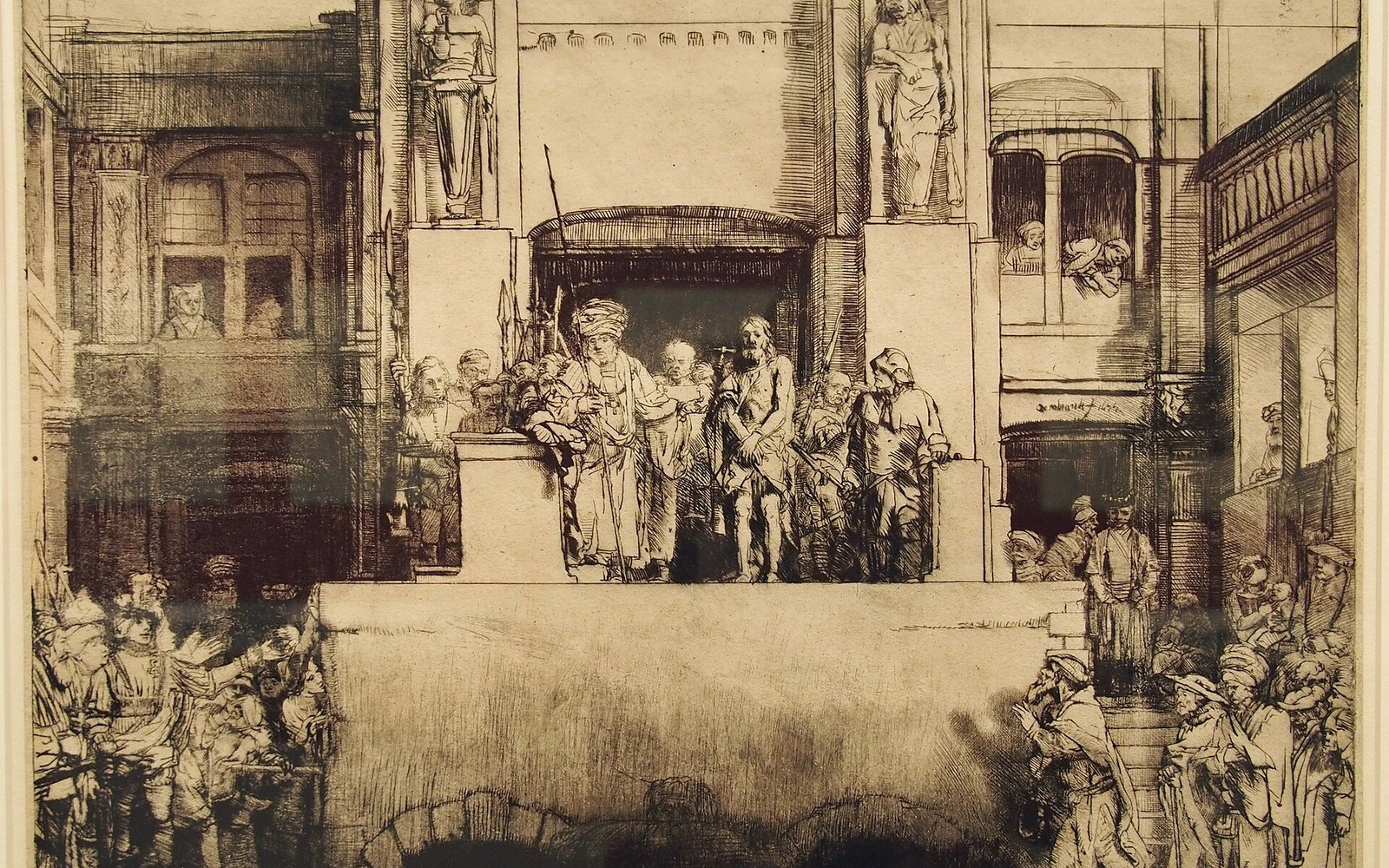
This kind of radical plate revision was not common, though it was not entirely without parallel in Rembrandt's own practice. The etching Christ Presented to the People underwent a comparably drastic alteration between states, with the crowd below the platform removed and replaced with an arched void.

In both cases, the revision makes the later state feel less narrative and more confrontational, as if Rembrandt pulled the viewer out of the story and into a more abstract encounter with the image.
What makes The Three Crosses unusual even within that context is the scale of the physical labour involved. Burnishing out drypoint and heavily worked etched line from a large copper plate is demanding work: the metal must be smoothed with a burnisher — a hardened steel tool — until the indentations are flattened and will no longer hold ink, then reworked with new marks.
The evidence of what was removed survives in impressions of the earlier states, many held in major print room collections.
The evidence of what was removed survives in impressions of the earlier states, many held in major print room collections. The Rijksmuseum holds a substantial group of impressions across the states, as does the British Museum, whose collection allows direct comparison of the plate's successive lives.
Impressions of the first state printed on Japanese paper — an imported, thin, buff-toned sheet prized for the warmth it lent to the ink — show the burr at its most productive, the shadows feathered and velvety in ways that later impressions cannot replicate.

A first-state impression on Japanese paper is, materially speaking, a different object from a third-state impression on European laid paper, even if the composition is the same.
The support changes the image: the ink sits differently, the tone of the paper reads through the open areas, and the overall luminosity shifts. Rembrandt's deliberate use of paper choice as a variable in printmaking is one of the more documented aspects of his practice as a printmaker, visible in the surviving impressions and confirmed by the range of papers found across his print production.

The fourth state prints with a different quality of darkness altogether. Much of the burr from the original campaign is gone, and the new marks are deep but harder-edged; the velvety shadow of the early states gives way to something more angular, more cut.
Some impressions of the fourth state are heavily inked, the plate tone — ink left deliberately on the surface rather than wiped clean — adding to the oppressive weight of the composition. Whether this inking was Rembrandt's own choice or that of later printers working from the plate after his death in 1669 is not always clear; the plate passed out of his hands, and post-mortem impressions exist in number.
The scholarship on the states was consolidated in the catalogue raisonné of Rembrandt's prints by Christopher White and Karel Boon, and later refined in the systematic treatment by Erik Hinterding, Ger Luijten and Martin Royalton-Kisch published through the Rijksmuseum.
Technical analysis of the plate itself — now lost, as most of Rembrandt's plates are — is necessarily conducted through the impressions, reading in the prints what the copper once held. That reading, impression by impression, state by state, remains the primary way of understanding what was there, what was removed, and in what order the work was done.